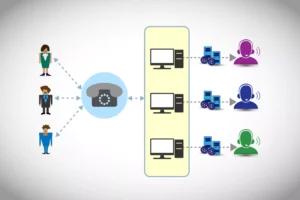
We provide VoIP phone systems to businesses in Anderson, IN, and throughout Madison County, offering design, installation, support, and ongoing optimization from a single local team. Our trained technicians handle every phase of your VoIP deployment, from the initial network assessment to post-install maintenance. Our business VoIP solutions integrate with Microsoft Teams, leading CRM platforms, and other tools your team already uses. We build every system on a network readiness review that protects call quality from day one.
VoIP Phone Systems for Anderson Businesses
When your phone system is not working the way it should, your team feels it immediately. Calls get missed, staff working remotely along the I-69 corridor cannot connect reliably to the main office, and your monthly phone bill fluctuates with no clear explanation. A properly designed VoIP system addresses all of that by replacing aging hardware and fragmented phone infrastructure with a flexible, cloud-capable platform built around how your business actually operates.
The operational benefits go well beyond cost savings. VoIP gives your team better call routing so incoming calls reach the right person the first time, not the third transfer. It supports staff whether they are at a desk in Anderson, working from home, or on the road, without requiring separate systems or workarounds. And because VoIP is software-driven rather than hardware-dependent, your phone system grows with your business without requiring a full replacement every time you add staff or open a new location.
Customization is where the real difference shows up. A healthcare practice operating near Community Hospital Anderson has different routing needs than a manufacturing facility along the SR 9 corridor or a professional services firm with multiple offices across Madison County. A properly designed VoIP system reflects those differences. Call routing rules, auto attendants, compliance considerations, and integration requirements all get built into the system from the start rather than added on later.
Why Choose Taylored Systems for VoIP Phone Systems in Anderson, IN
When you work with us, you have one local team for your voice systems, network cabling, IT support, and physical security. For Anderson businesses, that means fewer vendor handoffs. One call reaches the team that knows your environment, with no routing between a phone vendor, a cabling contractor, and a separate IT support line.
As an authorized dealer for Zultys, we bring something a national reseller cannot replicate. Our technicians are trained and certified on the platforms they install, your support is backed by the manufacturer, and accountability runs from the initial design through the ongoing support relationship.
How do you design a VoIP solution around my business workflow?
We start with a discovery conversation, not a product pitch. Before we recommend any configuration, we take time to understand your call volume, your staffing patterns, how many locations you operate, and whether your industry carries specific routing or compliance requirements. That information drives the design. Call routing maps reflect your real call flow, auto attendant scripts match how you want callers greeted and directed, ring group structures fit your staffing reality, and the decision about whether hosted, hybrid, or on-premises is the right configuration gets made before any hardware ships.
VoIP Provider Services in Anderson
For businesses with offices in Anderson and surrounding communities, we can build a unified communication environment with centralized administration and consistent routing across all locations. Whether you have two offices or ten, the system behaves like a single phone network, and our team has full visibility across the whole environment.
What to Expect: The Taylored Systems VoIP Implementation Process
We begin with a discovery meeting where we document your call flow requirements, staffing structure, locations, and any compliance or industry-specific needs. From there, we assess your existing network infrastructure for bandwidth capacity, latency, and configuration requirements, establishing QoS and VLAN settings to prioritize voice traffic.
Once the network review is complete, we submit your existing business phone numbers for porting and configure call forwarding to maintain continuity during the transition window. We then deploy hardware, configure extensions, and build auto attendants and ring groups to your routing specifications, connecting and verifying any integrations with your existing platforms.
Before go-live, your team receives hands-on training on the new system, covering how to manage call routing changes, use mobile and softphone applications, and access call analytics. After go-live, we remain your ongoing support contact for adds, moves, changes, troubleshooting, and system optimization.
Support You Can Count On
We provide 24/7 dispatch customer service, meaning issues are routed to trained technicians regardless of when they occur. Ongoing maintenance includes system updates, routing adjustments, and proactive monitoring to catch performance issues before they affect your team.
What does VoIP installation and setup include in Anderson, IN?
When we install a VoIP system for your Anderson business, the process includes a network and cabling assessment, hardware deployment, system configuration, number porting, team training, and post-install support. You are walking through a structured process with a team that is accountable for the outcome at every stage.
The network assessment covers the variables that determine whether your calls sound good or suffer from quality issues. We measure bandwidth availability against your expected call volume, review latency and existing cabling, and check switch configuration. If your current infrastructure has gaps that would affect call quality, they are identified and resolved before installation begins.
Hardware and system configuration follows the assessment. We deploy desk phones, set up softphone applications for remote staff, build and test auto attendant scripts, configure ring groups, and connect and verify your CRM integrations.
We stay available for changes, additions, and troubleshooting as your team settles into the new system and your needs evolve.
Can I keep my existing business phone numbers when switching to VoIP?
Yes. In nearly all cases, your existing business phone numbers can be ported to your new VoIP system. You do not have to change the numbers your clients already have, and the porting process is handled as part of the implementation so your team stays reachable throughout.
We submit your existing numbers to the new carrier for porting. That process takes a defined window of time, typically measured in days to a few weeks, depending on the carrier. During that window, we configure call forwarding on your existing numbers so incoming calls continue to reach your team without interruption.
Porting timelines can shift depending on your current carrier, and businesses with multiple numbers or toll-free direct inward dial numbers should plan for a slightly longer coordination window.
How long does it take to transition to a new VoIP phone system?
Smaller businesses with straightforward routing may be live within two to three weeks of the discovery conversation, and we structure the process at every stage to keep disruption to a minimum. Larger or more complex deployments take longer, and that timeline is confirmed in writing before any work begins.
The variables that most affect timeline are the number of users, the number of locations, the complexity of your routing rules, and how long porting takes with your current carrier. Each of those factors is surfaced during the discovery conversation so there are no surprises mid-project.
For customer-facing businesses in Anderson, downtime during a phone cutover is a real operational risk, and we plan around it. We schedule cutovers to avoid peak call hours and run parallel systems where needed so your team is never caught without a working phone line during the transition.
VoIP Features and Integrations That Improve How Your Team Works
Features fall into two categories: how calls are handled within the system, and how the system connects to the platforms your team already uses. Both matter, and both are part of what we configure when building out your VoIP solution.
The call handling features we configure most often start with auto attendant and IVR, which routes callers to the right department or individual without requiring a live receptionist on every call. Ring groups and hunt groups distribute incoming calls across a team so no call goes unanswered during high-volume periods, and call queues hold callers in sequence with on-hold messaging during peak hours. For businesses that need documentation, call recording captures calls for quality review, training, and compliance purposes, and call analytics and reporting tracks missed calls, call duration, and queue performance to inform staffing and routing decisions. Voicemail-to-email transcription delivers voicemails as readable text so messages are never missed or delayed.
For staff working in and out of the office, we support both physical desk phones and software-based softphone clients on computers and mobile devices. Simultaneous ring and call forwarding ensures calls reach the right person whether they are at their desk, on the road, or working remotely.
The integrations we configure connect your phone system directly to the tools your team already uses. We connect your system to Microsoft Teams, enabling business calling within the Teams interface so voice, chat, and meetings operate from a single platform. For sales and marketing teams, we configure HubSpot integration to log call activity, surface contact records during calls, and connect phone data to your workflows. Salesforce integration links call records to CRM data, supports click-to-dial, and gives sales and service teams full call context without switching applications. Additional CRM integrations are available depending on your existing technology stack.
Call Quality, Security, and 911 Readiness
A VoIP system that drops calls, routes 911 incorrectly, or leaves your business exposed to unauthorized use is not a functional phone system regardless of its feature list. Call quality, security, and emergency calling compliance are core requirements that need to be built into the design from the start.
We address all three proactively. Call quality depends on network readiness. Security depends on proper configuration and ongoing monitoring. Emergency calling compliance depends on understanding both federal requirements and Indiana-specific rules.
Call Quality and Network Readiness
The quality of your VoIP calls is determined by your network before it is determined by your phone system. Bandwidth, latency, jitter, and packet loss are the variables that matter. When those variables are not controlled, calls sound choppy, drop unexpectedly, or fail to connect. QoS configuration and VLAN setup are how those variables get managed, and a proper network assessment before installation is how problems get identified before they ever affect your team.
|
Readiness Item |
What It Involves |
Why It Matters |
|
Bandwidth assessment |
Measurement of available upload/download capacity against expected call volume |
Insufficient bandwidth causes dropped calls and audio degradation |
|
QoS configuration |
Prioritization of voice traffic on the network to prevent interruption by data-heavy applications |
Prevents jitter and packet loss during high-usage periods |
|
VLAN setup |
Segmentation of voice traffic onto a dedicated network path |
Isolates voice from other traffic, improving consistency and security |
|
Cabling review |
Inspection of existing Cat6 or fiber infrastructure for faults or capacity limits |
Poor cabling is a leading cause of intermittent call quality issues |
|
Switch and router assessment |
Verification that PoE switches and routers are capable of supporting VoIP loads |
Underpowered hardware creates bottlenecks that audio traffic cannot tolerate |
|
Firewall and SIP configuration |
Confirmation that firewall rules allow SIP traffic without degrading call signaling |
Misconfigured firewalls are a common cause of one-way audio and dropped calls |
|
Proactive monitoring plan |
Establishment of ongoing network performance monitoring after go-live |
Catches quality degradation before it becomes a service disruption |
Which Phone System Model Fits Your Business?
Not every business needs the same phone system setup, and the right choice depends on your team size, your existing infrastructure, and how much control you want over the hardware. Here is how cloud-hosted, hybrid, and on-premises models compare across the factors that matter most.
|
|
Cloud-Hosted |
Hybrid |
On-Premises |
|
Best for |
SMBs, remote teams, and multi-site businesses without dedicated IT staff |
Businesses transitioning from legacy systems or with partial existing infrastructure |
Larger organizations with dedicated IT teams and strict data control requirements |
|
Hardware required |
Minimal: phones and an internet connection |
Mixed: some on-site hardware with cloud-managed components |
Full on-site PBX hardware and infrastructure |
|
Maintenance |
Managed by provider |
Shared between provider and internal IT |
Shared between provider and internal IT |
|
Scalability |
High: add users and locations easily |
Moderate: depends on existing infrastructure |
Lower: hardware capacity must be planned and purchased in advance |
|
Upfront cost |
Lower |
Moderate |
Higher |
|
Monthly cost |
Predictable per-user billing |
Variable |
Lower long-term operational cost once hardware is paid off |
|
Ideal organization type |
Growing SMBs, distributed teams, businesses without a server room |
Businesses with existing PBX investment, phased migrations |
Enterprise, regulated industries with on-site data requirements |
Security
Every VoIP deployment includes encryption for call data in transit using SRTP and TLS protocols. We apply access controls and multi-factor authentication to admin portals and maintain audit logs for call records. These are standard practice on every deployment.
Toll fraud is a real concern for businesses running on VoIP. It happens when unauthorized parties access your VoIP infrastructure and make calls at your expense. Without early detection, the charges can be significant. STIR/SHAKEN is the framework that validates caller identity and reduces spoofed inbound calls, providing one layer of protection against unauthorized access to your system. For Anderson businesses in regulated industries, including healthcare and financial services, there are additional compliance considerations around call data storage, access, and retention that need to be addressed during the design process.
Emergency Calling and 911 Compliance
As of 2020, federal law under Kari's Law requires that multi-line telephone systems in the United States allow direct 911 dialing without requiring a user to first dial 9 or any other prefix to reach an outside line. This requirement is enforced by the FCC and documented through 911.gov. If your phone system requires a prefix to dial out, it is not compliant, and that gap needs to be corrected during installation.
RAY BAUM's Act adds a second layer of requirement. When a 911 call is placed from a business VoIP system, the system must transmit a specific, accurate location, not just the main address on file. The correct floor, suite, or building must be identifiable to the Public Safety Answering Point receiving the call. The FCC enforces this requirement for multi-line telephone systems, and it applies to VoIP deployments regardless of whether the system is hosted or on-premises.
At the state level, the Indiana Statewide 911 Board administers emergency communications requirements across Indiana, and Indiana Code IC 36-8-16.7 establishes the legal framework for statewide 911 services. Businesses in Anderson and Madison County need their VoIP systems configured in compliance with both federal requirements and Indiana's specific framework.
For organizations where 911 configuration is a critical operational and legal requirement, getting these settings right during installation is a legal requirement, not an afterthought. We address both Kari's Law and RAY BAUM's Act compliance as part of every VoIP deployment, so your system is live and compliant from day one.
Get a VoIP Phone System Quote in Anderson With Taylored Systems
Businesses in Anderson, across Madison County, and in the surrounding Indiana communities we serve work with a full-service VoIP partner with proven local experience. Taylored Systems is a local team that has done this work here, with Anderson businesses, and is ready to do it for yours.
The first step is a short discovery conversation. You walk us through your current setup, the challenges you are running into, and what you need the new system to do. There are no lengthy forms and no commitment required before you have seen your options. It is a direct conversation with a team that knows the technology and can give you a clear picture of what fits your business.
From there, you have three paths forward. You can request pricing for a specific configuration once we have scoped your configuration together. You can schedule a demo of the platform to see how the features and integrations work before making a decision. Or you can speak directly with one of our specialists about a specific challenge or requirement you are trying to solve.
Ready to experience a true technology partnership? Contact Taylored Systems today to learn more about how we can support your business.